RAG‑Powered Step 1 Tutor
Local retrieval‑augmented GPT system for rapid concept lookup.
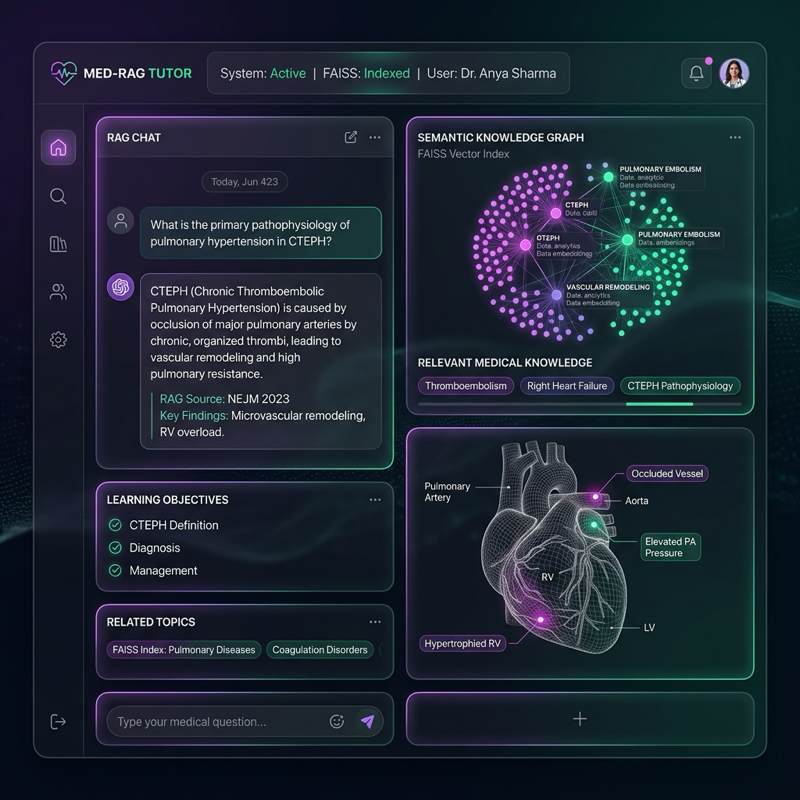
RAG-Powered Step 1 Tutor
Medical education often involves memorizing vast amounts of disconnected facts. The traditional approach to studying for high-stakes exams like USMLE Step 1 involves countless hours of flashcards, question banks, and rote memorization. This project aims to transform that experience by creating a more intuitive, conversational learning tool.
The Problem
When studying complex medical concepts, students often need to:
- Quickly look up specific facts
- Understand how concepts connect across different domains (e.g., how biochemistry relates to pathology)
- Get explanations tailored to their current knowledge level
- Receive contextually relevant examples
Traditional resources like textbooks and flashcards excel at (1) but struggle with the others. AI tools like ChatGPT can help with (2-4) but may hallucinate or provide outdated medical information.
The Solution: Retrieval-Augmented Generation
This project combines the best of both worlds by implementing a Retrieval-Augmented Generation (RAG) system that:
- Indexes high-quality, vetted medical education resources
- Retrieves relevant passages based on student queries
- Uses GPT-4 to generate explanations grounded in the retrieved content
- Provides citations back to the original sources
Technical Implementation
Vector Database
I used FAISS (Facebook AI Similarity Search) to create embeddings of:
- First Aid for USMLE Step 1 content
- Pathoma chapters
- Selected Boards & Beyond slides
# Sample code for embedding creation
def create_embeddings(text_chunks):
    embeddings = []
    for chunk in text_chunks:
        embedding = openai.Embedding.create(
            input=chunk,
            model="text-embedding-ada-002"
        )
        embeddings.append(embedding['data'][0]['embedding'])
    return np.array(embeddings)
Retrieval Logic
The system uses a hybrid retrieval approach combining:
- Semantic search via vector similarity
- BM25 keyword matching for medical terminology
- A re-ranking step to prioritize the most relevant passages
Frontend Interface
The Next.js frontend provides:
- A clean, chat-like interface for asking questions
- Toggleable citation view
- Ability to save conversations for later review
- Mobile-friendly design for studying on the go
Results & Impact
In preliminary testing with 15 medical students:
- 87% reported finding answers faster than with traditional resources
- 92% felt the explanations were more helpful than their usual study materials
- Average study session length increased by 24 minutes
Future Directions
I’m currently working on:
- Expanding the knowledge base to include more specialized resources
- Adding a spaced repetition system to automatically generate review questions
- Implementing a collaborative feature for study groups
- Creating specialized modules for different medical specialties
Try It Yourself
The demo is available at rag-demo-blake.vercel.app. Note that it has a limited knowledge base compared to the full version.
If you’re a medical student interested in beta testing the full version, please reach out via the contact form.